Menu

Friday, November 15, 2013

C & C++- question & ans

Q 1) What does this code do?
 #include<stdio.h>
 void func(char s[],int c)
 {
     int i,j;
     for(i=j=0;s[i]!='\0';i++)
         if(s[i]!=c)
             s[j++]= s[i] + s[i]==c ;
     s[j]='\0';
 }
 int main()
 {
     char s[]=“Hello world";
     func(s,'k');
     printf("%s",s);
     return(0);
 }
Output:  empty string or nothing
Explanation: The subroutine takes a string and a character, if the sum of 2 present character ASCII value is equal to the ASCII value of the character C then a 1 is added to the string s (s[i]+s[i]==c) and since the sum will never be equal to the ACSII value of C the string will remain empty
 
Q2)    Predict the output of the following piece of code. Assume that bit position 0 is at the right end and that i and j are sensible positive values.
 #include<stdio.h>
 unsigned getbits(unsigned a,int i,int j)
 {
     return(a>>(i+1-j)) & (~0<<j);
 }
 int main()
 {
     unsigned num=128;
     printf("%d\n",getbits(num,4,1));
     return(0);
 }
Output: 16
Explanation:

a>>(i+1-j) equals 8 ie binary value 00001000. (~1<<j) equals 15 i.e. binary value 00001111.Binary & of these two values gives us 00001000 which is equal to 16
 
Q 3)  Will this code work properly? If yes why? If not why not?
 #include<stdio.h>
 void swap(int *a,int *b)
 {
     *a=*a+*b;
     *b=*a-*b;
     *a=*a-*b;
 }
 int main()
 {
     int a=3617283450;
     int b=3617283449;
     swap(&a,&b);
     printf("%d %d\n",a,b);
     return(0);
 }
Explanation : For some systems it will return a value but it is garbage value. For some systems it won't work because of overflow in the statement *a=*a+*b;

Q 4) What will be the output of the following code
void swap(int,int);
void main()
{ int a=10,b=15;
clrscr();
printf("Befor swap a=%d ,b=%d",a,b);
swap(a,b);
printf("\nAfter swap a=%d ,b=%d",a,b);
getch(); }
void swap(int a, int b)
{ int c;
c=a;
a=b;
b=c; }

Output: Before swap a=10,b=15 After swap a=10,b=15
Explanation: a and b are auto variable (default storage class is auto) . Here its scope is only within main function. After the main function both a and b will die. We are swapping outside the main function so value of a and b is not changing.

Q 5) What will be the output of the following code
char* myFunc (char *ptr)
{
ptr += 3;
return (ptr);
}
int main()
{
char *x, *y;
x = "HELLO";
y = myFunc (x);
printf ("y = %s \n", y);
return 0;
}
Output: LO
Explanation :The subroutine will increment the pointer to the current position of string by 3 and return the new position to calling program So when the printf statement is executed it prints characters after third position.

Q 6) What will be the output of following Code:
void myFunc (int x)
{
if (x > 0)
myFunc(--x);
printf("%d, ", x);
}
int main()
{
myFunc(5);
return 0;
}
Output: 0, 0, 1, 2, 3, 4,
Explanation : myFunc is calling itself recursively the call stack will be like this
myFunc(0)
myFunc(0)
myFunc(1)
myFunc(2)
myFunc(3)
myFunc(4)

Q 7) what will be the output of the following Code:
#include <stdio.h>
int i;
void increment( int i )
{
i++;
}
int main()
{
for( i = 0; i < 10; increment( i ) )
{
}
printf("i=%d\n", i);
return 0;
}
Output: It will loop indefinitely.
Explanation : Because the increment function is returning void and it will not increment the “i” needed in the for loop of main function as the for loop will expect “i” to be incremented in the loop itself
 
Q 8) What is the output of the following Code:
#include <stdio.h>
void func()
{
int x = 0;
static int y = 0;
x++; y++;
printf( "%d -- %d\n", x, y );
}
int main()
{
func();
func();
return 0;
}
Output :1 -- 1 1 -- 2
Explanation : the variable y is static for the subroutine thus it will maintain its value even after the control exits from the present call.

Q 9) What will be the output of following code
#include <stdio.h>
void inc_count(int *count_ptr)
{
(*count_ptr)++;
}
int main()
{ int count = 0;
while (count < 10)
inc_count(&count);
Printf(“%d “, Count); 
return (0);
}
Output:10
Explanation :The address of the count variable is passed to the inc_count function which increments and return the incremented value. This is also called pass by reference.

Q 10) What will be the output of the following code
#include <stdio.h>
#include <stdlib.h>
void func(int);
main()
{
void (*fp)(int);
fp = func;
(*fp)(1);
fp(2);
exit(EXIT_SUCCESS);
}

void func(int arg)
{ printf("%d\n", arg);
}
 
Output: 1 2
Explanation: the first call (*fp)(1); will call the function through its pointer and return the value passed as argument and the second call fp(2); will invoke the function normally and print the parameter value to the screen

C/C++- question & answer

  1. With every use of a memory allocation function, what function should be used to release allocated memory which is no longer needed?
    1. unalloc()
    2. dropmem()
    3. dealloc()
    4. free()
  2. void *ptr; myStruct myArray[10]; ptr = myArray;
    Which of the following is the correct way to increment the variable "ptr"?
    1. ptr = ptr + sizeof(myStruct);
    2. ++(int*)ptr; 
    3. ptr = ptr + sizeof(myArray);
    4. ptr = ptr + sizeof(ptr);
  3. main()
    { char *ptr = ” Hi How r U?”;
    *ptr++; printf(“%s\n”,ptr); ptr++; printf(“%s\n”,ptr);
    }
    1. Empty string
    2. Compile error
    3. Hi How r U?
      i How r U?
    4. Hi How r U? Hi How r U?
  4. int testarray[2][2][2] = {11, 22, 33, 44, 55, 66, 77, 88};
    What value does testarray[1][1][0] in the sample code above contain?
    1. 55
    2. 77
    3. 88
    4. 11
  5. int a=10,b; b=a++ + ++a;
    printf("%d,%d,%d,%d",b,a++,a,++a);
    what will be the output when following code is executed
    1. 12,10,11,13
    2. 22,10,11,13
    3. 22,11,11,11
    4. 22,13,13,13
  6. When reallocating memory if any other pointers point into same piece of memory do these pointers-
    1. need to be readjusted 
    2. they get readjusted automatically
    3. C does it on behalf of user
    4. none of above 
  7. Which of these are correct method of declaring pointer?
    1. char *p,
    2. char* p,
    3. char * p,
    4. char*p.
    1. I only
    2. I and II
    3. I, II and III
    4. all of above 
  8. What is the output of this code
    main()
    { int c[ ]={2.8,3.4,4,6.7,5};
    int j,*p=c,*q=c;
    for(j=0;j<5;j++)
    { printf(" %d ",*c);
    ++q; }
    for(j=0;j<5;j++)
    { printf(" %d ",*p);
    ++p;
    }
    }
    1. 2 2 2 2 2 2 3 4 6 5
    2. 2 2 2 2 2 3 4 6 5
    3. 2 2 2 2 3 4 6 5
    4. 2 2 2 2 3 4 6 5
  9. What will be the output of following code
    Int main(void)
    { int *p =NULL;
    int *c =(int*)malloc(sizeof(p));
    printf(" %0x" &c);
    return 0;
    }
    1. Some address
    2. Blank Screen
    3. Some integer value
    4. Garbage value
    5.  
  10. What is the output of the following program?
    void main()
    { int *ptr =55;
    clrscr();
    printf("%d", ++(ptr));
    }
    1. 54
    2. 55
    3. 56
    4. some address
  11. Find the output for the following C programr
    main()
    { char *ptr = "Ramco Systems";
    *ptr++;
    printf("%sn",ptr);
    ptr++;
    printf("%sn",ptr);
    }
    a. Ramco Systemsnamco Systemsn
    b. Ramco systems
    c. amco Systems
    d. Empty string
  12. main()
    {
    int a,b,result;
    printf("nEnter the numbers to be multiplied :");
    scanf("%d%d",&a,&b);
    result=0;
    while(b != 0)
    {
    if (b&01)
    result=result+a;
    a<<=1;
    b>>=1;
    }    printf("nResult:%d",result);
    }

    For a=8 & b=6 what will be the output
    1. 68
    2. 86
    3. 48
    4. 84
  13. Between a long pointer and a char pointer , which one consumes more memory?
    1. long pointer
    2. Char pointer
    3. Both will occupy same memory
    4. None of above
  14. main()
    { int a[]={2,4,6,8,10};
    int i;
    change(a,5);
    for(int i=0;i<=4;i++)
    printf("\n %d", a[i]);
    }
    change(int *b,int n)
    { int i;
    for(i=0;i<n;i++)
    *(b+i) = *(b+i)+5;
    }
    Output will be
    1. 2,4 6,8 10
    2. 7,9,11,13,15
    3. 5,7,9,11,13
    4. 3,5,7,9,11
  15. main()
    { int i;
    float *pf;
    pf = (float *)&i; *pf = 100.00;
    printf("n %d", i);}
    1. Some Integer not 100
    2. 100
    3. Runtime error.
    4. 0
  16. main()
    { int i, j, *p;
    i = 25;
    j = 100;
    p = &i;
    printf("%f", i/(*p) );
    }
    1. Compile erro
    2. 1.00000
    3. Runtime error.
    4. 0.00000
  17. main()
    {
    int i, j;
    scanf("%d %d"+scanf("%d %d", &i, &j));
    printf("%d %d", i, j);
    }
    1. Compile error
    2. 0, 0
    3. Runtime error.
    4. the first two values entered by the user.
  18. struct Foo
    { char *pName;
    };
    main()
    {
    struct Foo *obj = malloc(sizeof(struct Foo));
    clrscr();
    strcpy(obj->pName,"Your Name");
    printf("%s", obj->pName);
    }
    1. Name
    2. compile error
    3. Your Name
    4. Runtime error
  19. In the following code, in which order the functions would be called?
    x = f1(23,14)*f2(12/4)+f3();
    1. f1, f2, f3
    2. f3, f2, f1
    3. The order may vary from compiler to compiler
    4. None of the above
  20. What is the equivalent pointer expression for referring the same element a[i][j][k][l]?
    1. *(*(*(*(a+l)+k)+j))
    2. *(*(*(*(a+i)+j)+k)+l)
    3. *(*(*(*(a+l)+k)+j)i)
    4. None of the above


Answers-
1-d 2-b 3-c 4-b 5-d 6-a 7-d 8-a 9-a 10-d
11-a 12-c 13-c 14-b 15-a 16-a 17-d 18-c 19-a 20-b

How to solve UGC NET in Computer Science Paper II


On examining the previous year papers, it has been observed that the following pattern has been followed in the Paper-II for Computer Science
Subject No. of Questions
Discrete Structures/ Mathematics 5
Computer Arithmetic 5
Programming in C & C++ 5
Relational DB Design & SQL 5
Data & File Structures 5
System Software & Compilers 5
Operating Systems 5
Software Engineering 5
Computer Networks 5
Current Trends & Technologies 5
Total Questions 50

To clear the paper-II a candidate must acquire 40 marks. You can select any six subjects of your choice and prepare these subjects  thoroughly to aim for an attempt of 60 marks. So I hope it will work for you . 
Books recommended for the paper II
Most of the books that are recommended here contain large number of solved and unsolved problems. You must focus on the questions given at the back of chapters. In addition to these GATE( Computer Science) entrance test preparation book will be a good support to practice questions.
Subject Books
Discrete Structures/ Mathematics
1. Schaum's Outline Series, Discrete Mathematics.
2. 2000 Solved Problems in Discrete Mathematics, Schaum's Outline Series.
3. Discrete mathematical structures with applications to computer science,Jean-Paul Tremblay,R. Manohar.
Computer Arithmetic
1. Structured Computer Organization, Andrew S. Tanenbaum.
Programming in C & C++
1.Schaum's Outline of Programming with C,
Byron Gottfried.
2.Schaum's Outline of Programming with C++, John Hubbard
3.Let us C solution by Yashwant Kanetkar
4.Test Your C Skills - Yashavant Kanetkar
Yashwant Kanetkar
Relational DB Design & SQL
1. An introduction to database systems,C. J. Date
2.Schaum's Outline of Fundamentals of Relational Databases.by Ramon Mata-Toledo
Data & File Structures
1. Schaum's outline of theory and problems of data structures, Seymour Lipschutz
2. The Art of Computer Programming, Donald E. Knuth.
3. Data Structures and Algorithms, Alfred V. Aho, Jeffrey D. Ullman, John E. Hopcroft.
System Software & Compilers
1. Systems Programming and Operating Systems, D M Dhamdhere.
Operating Systems
1. Operating System Concepts, Silberschatz, Galvin, Gagne.
2. Operating Systems: Internals And Design Principles, Stallings
Software Engineering
1. Software engineering, Ian Sommerville.
2. An integrated approach to software engineering, Pankaj Jalote
3. Software engineering a practitioners approach - Roger S Pressman
Computer Networks
1. Computer Networks, Andrew S. Tanenbaum
2.Computer Networks, Behrouz Forouzan, Firouz Mosharraf
Current Trends & Technologies
Study about latest trends in computer Networks, Mobile computing, data mining and warehousing and the e-projects that are being initiated in India.

UGC NET September 2013: Question Papers with Answer Keys: Computer Science And Applications Paper II

1. A file is downloaded in a home computer using a 56 kbps MODEM connected to an Internet Service Provider. If the download of file completes in 2 minutes, what is the maximum size of date downloaded?
(A) 112 Mbits
(B) 6.72 Mbits
(C) 67.20 Mbits
(D) 672 Mbits

2. In_____CSMA protocol, after the station finds the line idle, it sends or refrains from sending based on the outcome of a random generator.
(A) Non-persistent
(B) 0-persistent
(C) 1-persistent
(D) p-persistent

3. Which of the following substitution technique have the relationship between a character in the plaintext and a character in the ciphertext as one-to-many?
(A) Monoalphabetic
(B) Polyalphabetic
(C) Transpositional
(D) None of the above

UGC NET Paper II

Q.1
Who is the father of Artificial Intelligence?
Q.2
The minimum number ofspanning trees in a connected graph with 'n' nodes is
Q.3
Which of the following is the programmable internal timer
Q.4
Microprogramming is designing of
Q.5
stack consists of
Q.6
In compilers the syntax analysis is done by
Q.7
The number of bytes of overhead in a SONET frame is
Q.8
The primary interactive method that people use to sense their environment is
Q.9
How many binary numbers are created with 8 bits?
Q.10
Which of the following codes uses 7 bits to represent a charactor?

UGC NET 2013 Exam Pattern


Session
Paper
Marks
Number of Questions
Duration
1
I (General awareness, reasoning, comprehension etc)
100
60 out of which 50 question to be attempted
1¼ hours (9.30 am- 10.45 am )
2
II (based on subject chosen by the candidate)
100
50 questions, all are compulsory
1¼ hours (10.45 am- 12 noon)
3
III (based on subject chosen by the candidate)
150
75 questions, all are compulsory
2½ hours (1.30 pm- 4 pm)

For more details about the Scheme of the Test, click on the link given below:
Scheme of UGC National Eligibility Test
Q.13)    
Computer is not being used in education as
 
Q.14)    
Which are not the computer sub-systems?
 
Q.15)    
Bharat Sanchar Nigam Limited (BSNL) has announced to stop a service which it continued for more than a century?
 
Q.16)    
Which of following is not the category of barriers in communication?
 
Q.17)    
Main objective of F.M. station in radio is-
 
Q.18)    
Effective communication occurs only if
 
Q.19)    
Which of the following is not the function of communication?
 
Q.20)    
According to Legons, communication means
 
Q.21)    
Instructions: Read the following paragraph carefully answer the question based on the same.
Corruption in India is has been a problem ever since the country had been having a multilayered administration by officers, ministers and other administrative chiefs. The corruption problem in ancient India, coupled with bribery, kept infesting the society more and more in an increasing rate. This is quite clear from the way the contemporary writers like Ksemendra and Kalhana have condemned the government officials, as well as other employees of different levels, in their celebrated works. Ksemendra in his Dasavataracaritam has advised the king to remove all the officials, ministers, generals and priests from office with immediate effect, who were either taking bribes themselves or have been indulging in corruption in some other way. Yet another work by Ksemendra, called Narmamala, depicts corruption bribery spreading fast like rampant maladies. He also found an answer to the much discussed question how to stop corruption in India of his time; he has explicitly addressed the contemporary intelligentsia to step forward and shoulder the responsibility of purging their folks.
Kalhana too was merciless in his condemnation of the corrupt government officers in India of his own time. He damned the officials outright and asked the king to stay alert from their evil entente. Kalhana has also cited some examples of top incidents of corruption in India of his days. He said that Bijja became even richer than the kind as he sought to unfair means of getting money, while Ananda managed to achieve a high post in the office by bribing his higher officials. 
Embezzlements in India was just the same problem in the yesteryears as they are now, mostly among the police and administrative officers. In fact, Kautilya has given a detailed list, referring to not less than forty ways of embezzlement that the treasury officers in his time were used to practice. The most common of them were pratibandha or obstruction, prayoga or loan, vyavahara or trading, avastara or fabrication of accounts, pariahapana or causing less revenue and thereby affecting the treasury, upabhoga or embezzling funds for self enjoyment, and apahara or defalcation. And he uses a nice metaphor too – just like one cannot resist tasting the drop of honey or poison on the tip of the tongue, a government servant can never resist devouring even a bit of the government revenue. Again, we cannot confirm if a fish under water is drinking water or not; similarly, ascertaining the bribery, corruption and embezzlement on the part of government officials and policemen were equally impossible. 
And no wonder, this huge amount of embezzlement in different spheres of the administration and in varied degrees led to the piling up of a huge amount of black money in Indian market in the age of the Arthasastra; nevertheless, we would not enquire into that in detail and make this article unnecessarily long. In brief, that caused all the similar problems we find today, including sudden and unpredictable hikes in the prices of essential goods. It would have been quite interesting to address the issue under the present economic circumstances of the present day India, but the scope of this article would ask to better leave that out.
 
Which of the following is true according to the passage?
I. Corruption is like a rampant disease which spreads like an epidemic. 
II. The main cause of corruption was bribes asked by administrative officers in ancient India.
 
Q.22)    
Instructions: Read the following paragraph carefully answer the question based on the same.
Corruption in India is has been a problem ever since the country had been having a multilayered administration by officers, ministers and other administrative chiefs. The corruption problem in ancient India, coupled with bribery, kept infesting the society more and more in an increasing rate. This is quite clear from the way the contemporary writers like Ksemendra and Kalhana have condemned the government officials, as well as other employees of different levels, in their celebrated works. Ksemendra in his Dasavataracaritam has advised the king to remove all the officials, ministers, generals and priests from office with immediate effect, who were either taking bribes themselves or have been indulging in corruption in some other way. Yet another work by Ksemendra, called Narmamala, depicts corruption bribery spreading fast like rampant maladies. He also found an answer to the much discussed question how to stop corruption in India of his time; he has explicitly addressed the contemporary intelligentsia to step forward and shoulder the responsibility of purging their folks.
Kalhana too was merciless in his condemnation of the corrupt government officers in India of his own time. He damned the officials outright and asked the king to stay alert from their evil entente. Kalhana has also cited some examples of top incidents of corruption in India of his days. He said that Bijja became even richer than the kind as he sought to unfair means of getting money, while Ananda managed to achieve a high post in the office by bribing his higher officials. 
Embezzlements in India was just the same problem in the yesteryears as they are now, mostly among the police and administrative officers. In fact, Kautilya has given a detailed list, referring to not less than forty ways of embezzlement that the treasury officers in his time were used to practice. The most common of them were pratibandha or obstruction, prayoga or loan, vyavahara or trading, avastara or fabrication of accounts, pariahapana or causing less revenue and thereby affecting the treasury, upabhoga or embezzling funds for self enjoyment, and apahara or defalcation. And he uses a nice metaphor too – just like one cannot resist tasting the drop of honey or poison on the tip of the tongue, a government servant can never resist devouring even a bit of the government revenue. Again, we cannot confirm if a fish under water is drinking water or not; similarly, ascertaining the bribery, corruption and embezzlement on the part of government officials and policemen were equally impossible. 
And no wonder, this huge amount of embezzlement in different spheres of the administration and in varied degrees led to the piling up of a huge amount of black money in Indian market in the age of the Arthasastra; nevertheless, we would not enquire into that in detail and make this article unnecessarily long. In brief, that caused all the similar problems we find today, including sudden and unpredictable hikes in the prices of essential goods. It would have been quite interesting to address the issue under the present economic circumstances of the present day India, but the scope of this article would ask to better leave that out.
 
What are the problems caused due to embezzlement?
I. Black money
II. Price rise
III. Increase in bribery
IV. Delayed justice
 
Q.23)    
Instructions: Read the following paragraph carefully answer the question based on the same.
Corruption in India is has been a problem ever since the country had been having a multilayered administration by officers, ministers and other administrative chiefs. The corruption problem in ancient India, coupled with bribery, kept infesting the society more and more in an increasing rate. This is quite clear from the way the contemporary writers like Ksemendra and Kalhana have condemned the government officials, as well as other employees of different levels, in their celebrated works. Ksemendra in his Dasavataracaritam has advised the king to remove all the officials, ministers, generals and priests from office with immediate effect, who were either taking bribes themselves or have been indulging in corruption in some other way. Yet another work by Ksemendra, called Narmamala, depicts corruption bribery spreading fast like rampant maladies. He also found an answer to the much discussed question how to stop corruption in India of his time; he has explicitly addressed the contemporary intelligentsia to step forward and shoulder the responsibility of purging their folks.
Kalhana too was merciless in his condemnation of the corrupt government officers in India of his own time. He damned the officials outright and asked the king to stay alert from their evil entente. Kalhana has also cited some examples of top incidents of corruption in India of his days. He said that Bijja became even richer than the kind as he sought to unfair means of getting money, while Ananda managed to achieve a high post in the office by bribing his higher officials. 
Embezzlements in India was just the same problem in the yesteryears as they are now, mostly among the police and administrative officers. In fact, Kautilya has given a detailed list, referring to not less than forty ways of embezzlement that the treasury officers in his time were used to practice. The most common of them were pratibandha or obstruction, prayoga or loan, vyavahara or trading, avastara or fabrication of accounts, pariahapana or causing less revenue and thereby affecting the treasury, upabhoga or embezzling funds for self enjoyment, and apahara or defalcation. And he uses a nice metaphor too – just like one cannot resist tasting the drop of honey or poison on the tip of the tongue, a government servant can never resist devouring even a bit of the government revenue. Again, we cannot confirm if a fish under water is drinking water or not; similarly, ascertaining the bribery, corruption and embezzlement on the part of government officials and policemen were equally impossible. 
And no wonder, this huge amount of embezzlement in different spheres of the administration and in varied degrees led to the piling up of a huge amount of black money in Indian market in the age of the Arthasastra; nevertheless, we would not enquire into that in detail and make this article unnecessarily long. In brief, that caused all the similar problems we find today, including sudden and unpredictable hikes in the prices of essential goods. It would have been quite interesting to address the issue under the present economic circumstances of the present day India, but the scope of this article would ask to better leave that out.
 
What does the author seems to suggest?
 
Q.24)    
Instructions: Read the following paragraph carefully answer the question based on the same.
Corruption in India is has been a problem ever since the country had been having a multilayered administration by officers, ministers and other administrative chiefs. The corruption problem in ancient India, coupled with bribery, kept infesting the society more and more in an increasing rate. This is quite clear from the way the contemporary writers like Ksemendra and Kalhana have condemned the government officials, as well as other employees of different levels, in their celebrated works. Ksemendra in his Dasavataracaritam has advised the king to remove all the officials, ministers, generals and priests from office with immediate effect, who were either taking bribes themselves or have been indulging in corruption in some other way. Yet another work by Ksemendra, called Narmamala, depicts corruption bribery spreading fast like rampant maladies. He also found an answer to the much discussed question how to stop corruption in India of his time; he has explicitly addressed the contemporary intelligentsia to step forward and shoulder the responsibility of purging their folks.
Kalhana too was merciless in his condemnation of the corrupt government officers in India of his own time. He damned the officials outright and asked the king to stay alert from their evil entente. Kalhana has also cited some examples of top incidents of corruption in India of his days. He said that Bijja became even richer than the kind as he sought to unfair means of getting money, while Ananda managed to achieve a high post in the office by bribing his higher officials. 
Embezzlements in India was just the same problem in the yesteryears as they are now, mostly among the police and administrative officers. In fact, Kautilya has given a detailed list, referring to not less than forty ways of embezzlement that the treasury officers in his time were used to practice. The most common of them were pratibandha or obstruction, prayoga or loan, vyavahara or trading, avastara or fabrication of accounts, pariahapana or causing less revenue and thereby affecting the treasury, upabhoga or embezzling funds for self enjoyment, and apahara or defalcation. And he uses a nice metaphor too – just like one cannot resist tasting the drop of honey or poison on the tip of the tongue, a government servant can never resist devouring even a bit of the government revenue. Again, we cannot confirm if a fish under water is drinking water or not; similarly, ascertaining the bribery, corruption and embezzlement on the part of government officials and policemen were equally impossible. 
And no wonder, this huge amount of embezzlement in different spheres of the administration and in varied degrees led to the piling up of a huge amount of black money in Indian market in the age of the Arthasastra; nevertheless, we would not enquire into that in detail and make this article unnecessarily long. In brief, that caused all the similar problems we find today, including sudden and unpredictable hikes in the prices of essential goods. It would have been quite interesting to address the issue under the present economic circumstances of the present day India, but the scope of this article would ask to better leave that out.
 
Which of the following is not correct on basis of the given passage? 
I. There are incidents available from ancient India where bribe has been offered to get a highest position. 
II. The problem and practices of corruption are easily traceable in modern era as compared to ancient times. 
III. Embezzlements of more than 40 types are prevalent in today’s time.
 
Q.25)    
Instructions: Read the following paragraph carefully answer the question based on the same.
Corruption in India is has been a problem ever since the country had been having a multilayered administration by officers, ministers and other administrative chiefs. The corruption problem in ancient India, coupled with bribery, kept infesting the society more and more in an increasing rate. This is quite clear from the way the contemporary writers like Ksemendra and Kalhana have condemned the government officials, as well as other employees of different levels, in their celebrated works. Ksemendra in his Dasavataracaritam has advised the king to remove all the officials, ministers, generals and priests from office with immediate effect, who were either taking bribes themselves or have been indulging in corruption in some other way. Yet another work by Ksemendra, called Narmamala, depicts corruption bribery spreading fast like rampant maladies. He also found an answer to the much discussed question how to stop corruption in India of his time; he has explicitly addressed the contemporary intelligentsia to step forward and shoulder the responsibility of purging their folks.
Kalhana too was merciless in his condemnation of the corrupt government officers in India of his own time. He damned the officials outright and asked the king to stay alert from their evil entente. Kalhana has also cited some examples of top incidents of corruption in India of his days. He said that Bijja became even richer than the kind as he sought to unfair means of getting money, while Ananda managed to achieve a high post in the office by bribing his higher officials. 
Embezzlements in India was just the same problem in the yesteryears as they are now, mostly among the police and administrative officers. In fact, Kautilya has given a detailed list, referring to not less than forty ways of embezzlement that the treasury officers in his time were used to practice. The most common of them were pratibandha or obstruction, prayoga or loan, vyavahara or trading, avastara or fabrication of accounts, pariahapana or causing less revenue and thereby affecting the treasury, upabhoga or embezzling funds for self enjoyment, and apahara or defalcation. And he uses a nice metaphor too – just like one cannot resist tasting the drop of honey or poison on the tip of the tongue, a government servant can never resist devouring even a bit of the government revenue. Again, we cannot confirm if a fish under water is drinking water or not; similarly, ascertaining the bribery, corruption and embezzlement on the part of government officials and policemen were equally impossible. 
And no wonder, this huge amount of embezzlement in different spheres of the administration and in varied degrees led to the piling up of a huge amount of black money in Indian market in the age of the Arthasastra; nevertheless, we would not enquire into that in detail and make this article unnecessarily long. In brief, that caused all the similar problems we find today, including sudden and unpredictable hikes in the prices of essential goods. It would have been quite interesting to address the issue under the present economic circumstances of the present day India, but the scope of this article would ask to better leave that out.
 
What could have made lengthier to this article?
 
Q.26)    
Which of the following is the exact definition given by Gage?
 
Q.27)    
What quality the students like the most in a teacher?
 
Q.28)    
Which is the personal characteristic of students?
 
Q.29)    
From Indian perspective, foundation of the best teaching
 
Q.30)    
What are the 3H in education?
 
Q.31)    
Which of the following is not the difference between Action Research (AR) and Basic Research (BR)?
 
Q.32)    
Which is the characteristic of research?
 
Q.33)    
The research based on the process of discovering new findings based on study of history-
 
Q.34)    
Errors that don’t remain in sampling
 
Q.35)    
Which of the following is not type of variable?
 
Q.36)    
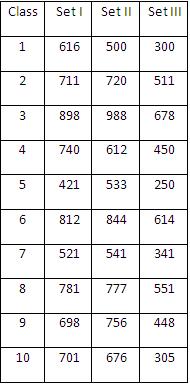
Instructions: The next three question is related to the reaction time experiments in a college. A table has been provided below on the scores given in three different sets on different times to students -


In respect of the scores, which of the following is true?
 
Q.37)    
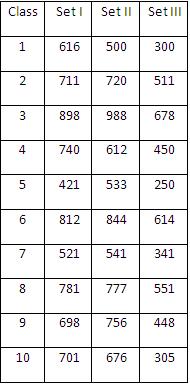
Instructions: The next three question is related to the reaction time experiments in a college. A table has been provided below on the scores given in three different sets on different times to students -


According to the data given-
 
Q.38)    
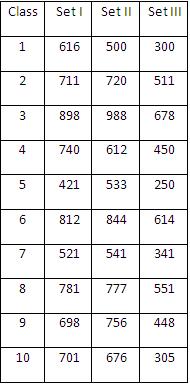
Instructions: The next three question is related to the reaction time experiments in a college. A table has been provided below on the scores given in three different sets on different times to students -


Which set exhibits maximum reaction time?
 
Q.39)    
Instructions: The next two question consist of a question and two statements with the number I & II. You need to decide whether the data provided in statements are enough to answer the question.
Read both the statements in the next two questions and give the answer
 
How A is related to B?
(I) B says, “I have only one brother”.
(II) A says, “I have only one sister”.
 
Q.40)    
Instructions: The next two question consist of a question and two statements with the number I & II. You need to decide whether the data provided in statements are enough to answer the question.
Read both the statements in the next two questions and give the answer
 
When is the Rishabh’s birthday this year?
(I) It is between January 13 & 15, January 13 being Wednesday
(II) It is not on Friday
 
Q.41)    
Rishi is brother of Shakti. Sweety is sister of Sharad. Shakti is son of sweety. How Rishi is related to Sweety?
 
Q.42)    
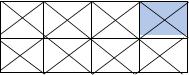
How many rectangles are there in the image given below?


Q.43)    
Instructions: Choose the correct number that replaces the question mark in the series-

2, 3, 8, 27, 112, ?
 
Q.44)    
Instructions: Choose the correct number that replaces the question mark in the series-
 
66, 36, 18, ?
 
Q.45)    
If DELHI is coded as CCID, how would you code BOMBAY?
 
Q.46)    
If in  a code language ORGANISATION is written as CBDWLQJWYQCL and OPERATION as CXFBWYQCL the how SEPARATION is coded?
 
Q.47)    
Instructions: Each of the question given below consists of a statement, followed by two arguments with their respective numbers as I & II. You need to judge which of the arguments is ‘strong’ argument while which one is ‘weak’ argument. Give your answer as 
 
Statement: Should India give away Kashmir to Pakistan?
Arguments: I - No, Kashmir is a beautiful state. It earns a lot of foreign exchange for India.
                   II- Yes. This would help settle conflicts.
 
Q.48)    
Instructions: Each of the question given below consists of a statement, followed by two arguments with their respective numbers as I & II. You need to judge which of the arguments is ‘strong’ argument while which one is ‘weak’ argument. Give your answer as 
 
Statement: Should a total ban be put on tapping wild animals?
Arguments: I – Yes. Trappers are making a lot of money.
                   II – No. Bans on trapping and hunting are not effective.
 
Q.49)    
Choose the odd word in the given options
 
Q.50)    
Choose the odd word in the given options